Category: Blog Article

  • How Legal Managers Can Overcome Resource Allocation Hurdles

    How Legal Managers Can Overcome Resource Allocation Hurdles

    Managing partners face multifaceted challenges in their pursuit of ensuring smooth operations and maintaining firm profitability. One aspect of firm management that often demands their attention is resource management, and more specifically, resource allocation. 

    We’ve heard from managing partners that some of the challenges include feeling overwhelmed, dealing with teams that have insufficient or inefficient workloads, and struggling to provide clients with the current status of their cases. Efficient (and fair) allocation of resources can be the difference between a thriving practice and one struggling to keep up with the ever-evolving legal landscape.

    In this article, we’ll walk you through some of the challenges of resource management for law firms and suggest ways to overcome common challenges. Let’s get started by examining the challenge of firm visibility.

    Lack of Firm Visibility

    Managing partners can often find themselves grappling with the lack of real-time visibility into their firm’s daily operations. However, being mindful of operations but not micro-managing is also important for team morale.

    A lack of visibility into the firm’s operations can have significant repercussions, especially when it comes to resource allocation. The absence of timely insights into case statuses, impending deadlines, and team workloads hinders the ability to make informed decisions.

    Consider a scenario where a managing partner is unaware of the current status of an important case. Without real-time visibility, they may allocate resources ineffectively, leading to missed deadlines or overburdened team members. This not only affects the quality of service but also impacts the firm’s overall efficiency.

    Manual Workload

    Another hurdle in inefficient resource management stems from the burden of manual tasks. Managing billable and non-billable hours, client communications, and report generation often rely on manual processes. 

    These tasks consume valuable time and energy, diverting focus from critical resource allocation decisions. They also create space for errors and inefficient work, and much of this time could be spent on more valuable tasks or providing better service for clients.

    Imagine a managing partner who spends hours meticulously tracking billable hours and juggling client communications manually. Such manual workflows not only drain time but also introduce the risk of errors and inefficiencies.

    Inefficient Communication

    Effective resource allocation requires seamless communication within the law firm. However, many firms still lack centralized communication platforms, leading to inefficiencies in team collaboration. Misunderstandings missed messages, and a lack of clarity can detract from a firm’s daily operations.

    Consider a situation where you often have clients calling your office to have updates, and only specific people have the information. The client may feel frustrated with your firm and with the need to wait even longer for a response. This client’s feelings could affect case outcomes and your firm’s client satisfaction ratings. But, by being proactive about your communication, you can be sure that clients (and team members) are kept informed about their cases without costly mistakes. 

    Strategies for Effective Resource Management

    To address these resource allocation challenges, managing partners can adopt practical strategies and agile methodologies. We know from experience that there are multiple ways to address challenges around resource management, and the solution may not be one size fits all.

    Here are some actionable steps:

    1. Implement Agile Workflows 

    Embrace agile methodologies to improve your resource allocation. The first step can often be observing and documenting your workflow to conduct further analysis. 

    By documenting your workflow, it’s easier to identify potential bottlenecks, improvements, and more. It’s important to remember that projects can be broken down into smaller, more manageable tasks. With smaller tasks, it’s easier to prioritize them and deliver superior service to clients accurately.

    You can think of this as dissecting what you currently do to make it more efficient. By breaking down a larger project into smaller tasks, it’s often easier to complete and prevents team members from feeling too overwhelmed. Learn more about checklists vs. tasks in our blog post.

    2. Continuous Improvement

    Encourage a culture of continuous improvement within the firm. Regularly review and refine workflows according to team feedback, identify bottlenecks, and seek opportunities for optimization. If you notice that team members are asking for more work or are waiting for other members to complete work, consider how to make this process more efficient. 

    With continuous improvement, you’ll be able to quickly adapt to any changes that happen within your firm or even on a more macro level within the legal industry. As well, improvements to processes can be made from your team’s experience working on certain projects that help shape the future of your operations.

    3. Transparent Communication

    Foster transparent and open communication practices. Implement periodic meetings or huddles to keep the team aligned and informed. Agile enthusiasts will recommend that these meetings be held daily, but we know that lawyers may not have a schedule that allows them to do this. We would recommend weekly meetings but this can change depending on your team and/or your operations.

    Effective communication is one of the most important aspects of a great team. From the top down, effective communication must be prioritized to create a great firm culture while also ensuring everyone understands priorities and resource allocation needs.

    Conclusion

    In conclusion, efficient resource management is pivotal for managing partners in law firms. Addressing the challenges of lack of firm visibility, manual workload, and inefficient communication is essential for optimizing resource allocation. 

    In our experience, we’ve noticed that firms that adopt innovative solutions and best practices allow their managing partners to thrive. With these solutions, managing partners can improve firm efficiency, make more strategic decision-making, and, ultimately, drive the success of their firm.

    We also know that solutions need to be tailored to your firm’s specific needs. This may not look the same for firms specializing even in the same practice area. Explore how Legalboards’ legal management software can help today by contacting us for a free consultation on how to become more efficient.

  • Optimizing Family Law Workflows

    Optimizing Family Law Workflows

    Family law practices oversee a range of legal matters, from divorce to child custody, adoption, and more. To effectively manage these cases, having a well-defined workflow is essential. Let’s explore two workflow approaches that are tailored to the complex landscape of family law. From there, you can see how having a documented process can help your team.

    General Family Law Workflow: One Board to Rule Them All

    For a broad overview of family law cases, a single-board approach can be highly effective. This can be done by creating a centralized Kanban board where each column represents a different stage of the legal process. From initial consultations to court proceedings, this board visually tracks the entire journey of every case in a family law workflow. 

    Whether it’s divorce, adoption, or child custody, all sub-practice areas coexist within this streamlined workflow and offer a comprehensive view of your practice’s operations. With this overview, you’ll be able to get a bird’s eye view of your operations while also being able to drill down into specific matters or tasks as needed.

    General Family Law Workflow: Board Organization

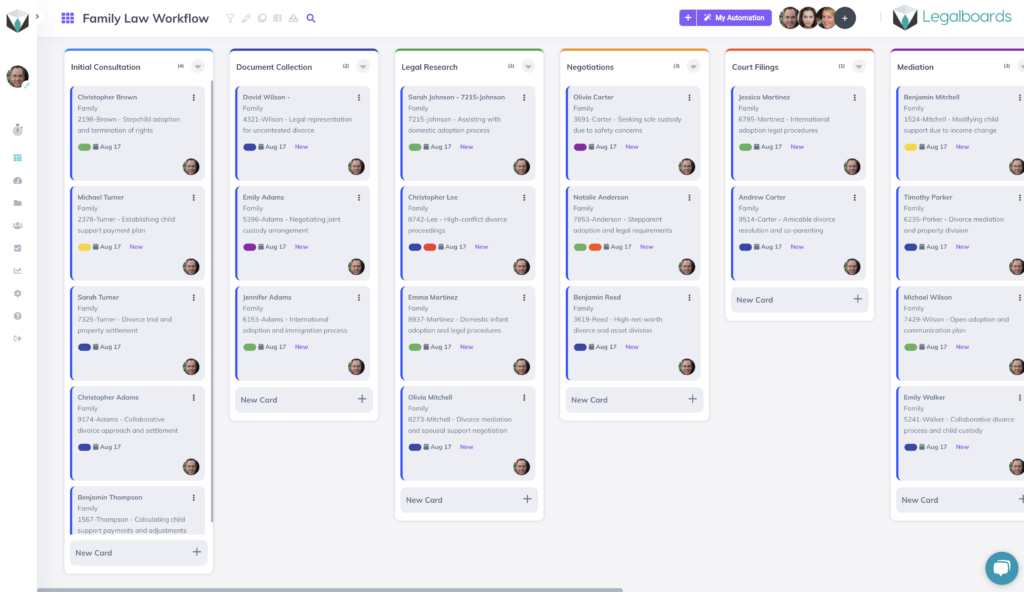
    For this general board, let’s say we organize this board (shown below) where every case is included but categorized using colored labels for specific kinds of cases. 

    General family law workflow

    Complex Management: Specializations

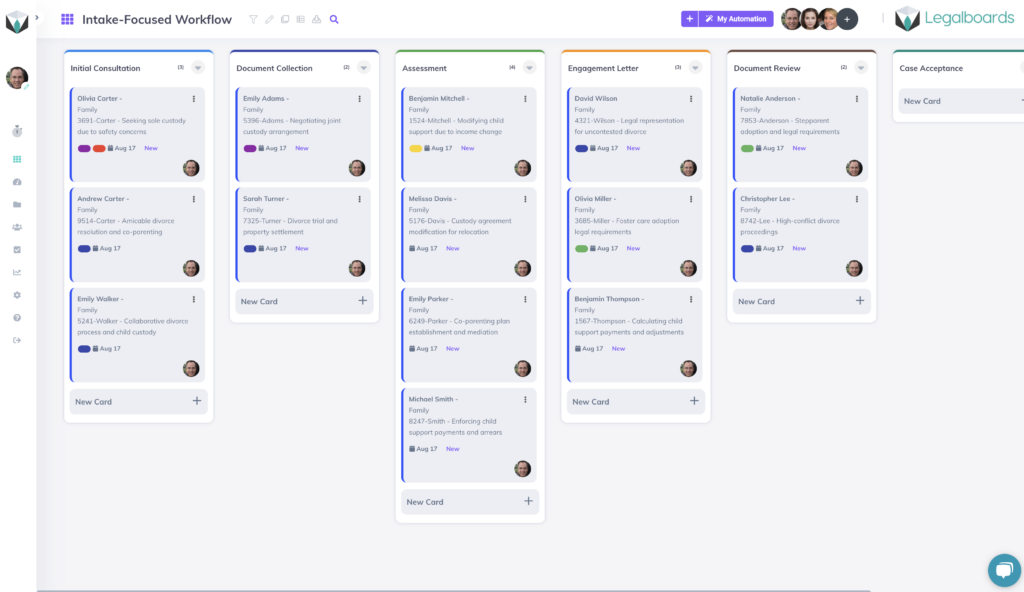
    Another option for organizing your workflow is to create a dedicated board for the intake process. This can make a world of difference when it comes to managing your client’s cases and providing them with superior client-led service. 


    Intake-Focused Workflow: Specialized Attention from the Start

    This involves creating a tailored intake board where each column represents a different stage (for example, initial consultation, document collection, and assessment). Each new case enters this pipeline, ensuring a consistent intake process across all family law sub-practice areas. 

    Customized task automation can send clients essential documents, schedule appointments, and track progress. This specialized approach guarantees that from the beginning, no crucial details are forgotten. 

    Specialized Family Law Workflows: Divorce and Adoption

    Finally, you could also organize your board by specific specialized workflows. Because family law covers a wide range of case types, it can help you to organize those that still roughly follow the same process or require similar management.

    Two examples of this are divorce and adoption cases. These cases usually follow the same steps so using specific boards for each can be helpful. We’ll illustrate this with two examples.

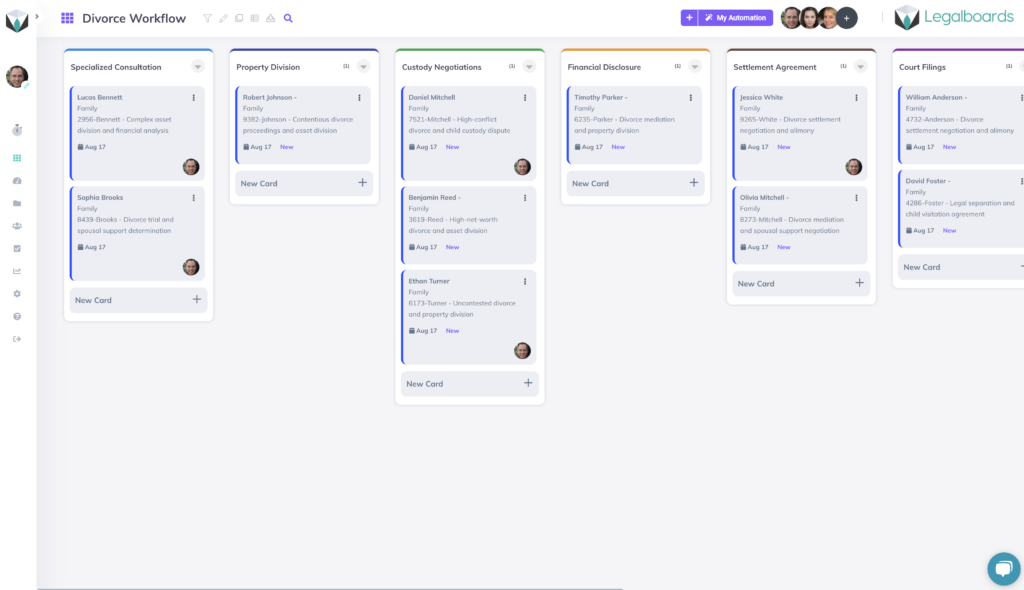
    Divorce Workflow

    For divorce cases, you could create a dedicated workflow that includes stages like property division, custody negotiations, and settlement. In Legalboards, we have divorce board templates (learn more about that here) that can be customized to your specific needs.


    Each column should represent a different stage of a case. This can be as detailed or high-level as you wish, but often having specific columns is much more helpful to you and your team. Custom fields can then capture financial details, while task automation ensures critical court deadlines are met.

    Example family law workflow- divorce board

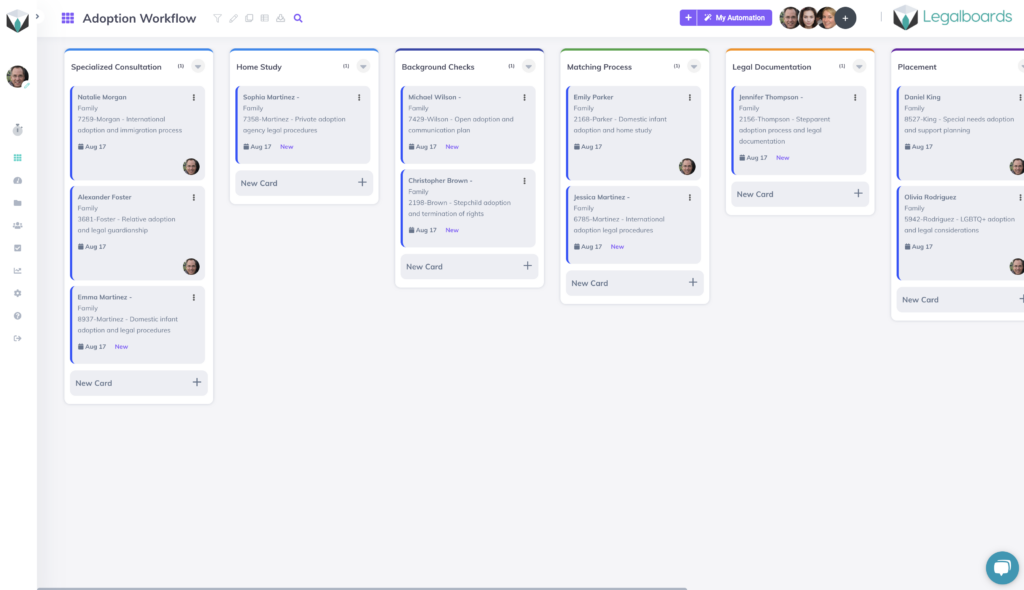
    Adoption Workflow

    Adoption cases demand empathy and precision from legal professionals to deliver great service to clients. Developing a workflow with stages like home study, background checks, and finalization can help lawyers manage cases. 

    Task assignments can keep your team informed about important milestones, while automated reminders guarantee that time-sensitive actions are never overlooked.

    Adoption workflow example in Legalboards

    Want to Get Started Quickly?

    If you’re interested in getting started quickly with Legalboards, you can use one of our templates, which the process is shown below, or contact us for a dedicated setup session.

    Conclusion

    Family law requires workflows that balance flexibility and specificity that reflect the often delicate nature of this practice area. Implementing the Kanban framework can help legal professionals deliver superior service, improve client satisfaction, and enhance the efficiency and productivity of legal teams.

    Whether you decide that a centralized board, intake-focused, or specialized boards are best for your workflow, it will aid you in gaining clarity about matters. With Legalboards, you can also easily implement this framework with a legal-specific solution to manage every aspect of your family law cases. 

  • MyCase Integration

    MyCase Integration

    We’re excited to be teaming up with MyCase to help busy lawyers get (and stay) organized! The MyCase and Legalboards integration will allow you to get back to practicing law, not administrative tasks.

    By combining Legalboards and MyCase, you can start saving time while working in a new visual way. Legalboards provides some great advantages to MyCase users to help make their case management software run smoothly.

    Benefits of Integrating MyCase + Legalboards

    1) Legalboards Automation Capabilities

    Legalboards allows you to automate various aspects of your work. Common automations include sending email updates, checking in on clients after certain periods, checklist creation, and more.

    Automated emails are to be sent based on triggers like time or card movement, so team members (or even clients) can stay updated on their matter’s progress. The time trigger is especially helpful for ensuring the continued progress of matters.

    For example, if you have an inactive or delayed board, you can set up emails to be sent to the responsible attorney to check in on that matter. If you want to learn more about how these work, check out our automation resources.

    2) Visualizing and Organizing Your Work

    With Legalboards you can easily visualize and organize your matters. The minimal Kanban user interface allows you to see at a glance what stage your matters are at without having to open each case file. Through customizations to the board, you can tailor your account to reflect your workflow accurately.

    As you can see in the screenshot below, how your work is progressing in Legalboards can be understood at a glance. It’s up to you how customized you want to make your board/cards. With the customization capabilities, you can add checklists and custom labels (including colors) to cards so you can quickly navigate your matters.

    Within the task center, Legalboards also has a calendar view so you can see your matter’s timeline in a simple format.

    3) Two-way Synchronization

    By integrating MyCase, your data will be automatically synced. Because of this, you won’t need to input your data twice. The specific fields that are synced between MyCase and Legalboards are the following;

    • Contact information: first and last name, email, and phone number; and
    • Matter information: name, case number, opened date, practice area, description, SOL date, and clients.

    Get Integrated

    To use the MyCase integration, you’ll need to first connect your MyCase and Legalboards accounts. Learn how to do so in the video below;

    Learn more about this integration here, or contact us for more help!

  • Highlights from Clio’s “Legal Trends Report” and What They Mean For You

    Highlights from Clio’s “Legal Trends Report” and What They Mean For You

    Every year, Clio releases the Legal Trends Report that helps lawyers take a look at the state of the industry based on the extensive research that the Clio team collects, deciphers, and provides insights on. As we’re all short on time, we’ve gone through the 2022 report and will provide you with some key insights from the report.

    1: Increased Demand for Services Driving The Need For Productivity

    With increased demand for legal services over the past year, there has also been an increase in the amount of work that lawyers are required to complete. As seen below (2022 Legal Trends Report 13), lawyers are billing more hours than ever during 2022.

    However, Clio also reports that only 33% of a typical 8 hour work day is actually spent on billable work, which translates to under 3 hours.

    So, the question is, is the high caseload sustainable? How does this affect the mental health of those within the legal industry?

    2. Optimizing Workdays

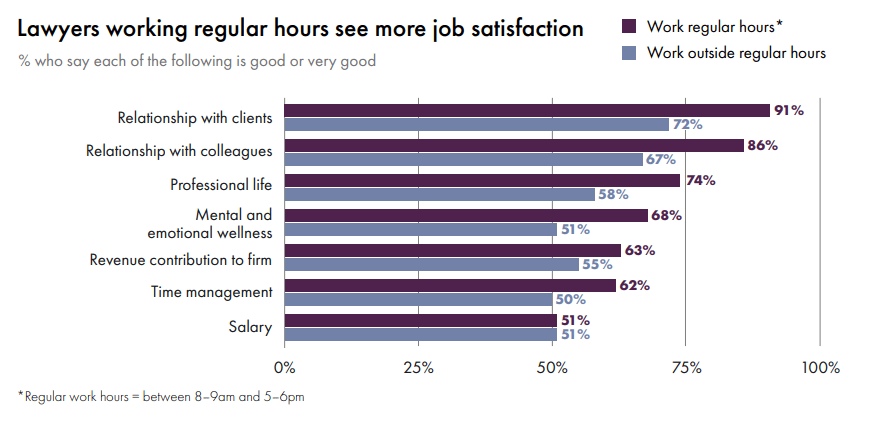
    Unsurprisingly, Clio found that many in the legal profession are looking for flexibility in their work- whether that be by the hours they work or where they do said work. It’s important to note that office use has declined, virtual meetings are actually preferred by clients, and legal professionals are looking to have some combination of hybrid work. 

    49% of lawyers say they prefer working from home and 45% prefer meeting with clients virtually (2022 Legal Trends Report). With these strong indications of variable locations being shown, it increases the risk of professionals to blur the line between work and their personal lives. Lawyers may prefer to work outside of the typical work-day hours (either 8/9 to 5/6), and prefer to communicate with clients and colleagues outside of work (2022 Legal Trends Report). And, how is this achievable? By introducing technology.

    All of these factors need to be balanced with the well-being of those within the industry. Operating at a high-level 24/7 is not sustainable. Combined with the need for agility in response to an uncertain economy, optimizing current processes is essential.

    3. Becoming “Antifragile” (or, Agile)

    Having the ability to quickly adapt to challenges is extremely important for all businesses to succeed. As we’ve all seen over the span of the pandemic, pivoting is sometimes a crucial part of business longevity. While Clio describes this as antifragile, we prefer to use the term agile. 

    Clio argues that the use of cloud-based legal practice management (LPM) technology helps firms become more agile, and we’d agree. This technology helps professionals to stay connected to team members and clients, provide better service, and help with mental health (2022 Legal Trends Report 41)

    Lawyers Working Regular Hours See More Job Satisfaction, “2022 Legal Trends Report.” Clio, Clio, 10 Oct. 2022, https://www.clio.com/resources/legal-trends/2022-report/.

    Looking to The Future

    As the report shows, 2021 was a rebound year for the legal industry. Demand for legal services increased while the industry recovered from the disruptions from the early days of the pandemic. However, the lines between work and life have become increasingly blurred with the increased flexibility of work and variable locations.

    Firms and legal practitioners are now looking for ways to remain competitive and respond to upcoming challenges. Technology (and automation) are one of the strategies used to mitigate risks. As shown in the Legal Trends Report, technology can help provide excellent service to clients, and with automation, can improve client perception of the services they are receiving. In addition to this, technology and automation helps lawyers manage their heavy caseloads and be more productive.

    To learn more about automation and how it can help your firm, check out our other resources.

  • How Clio’s Launch//Code 2022 Winners Are Leading The Way To Legal Practice Agility

    How Clio’s Launch//Code 2022 Winners Are Leading The Way To Legal Practice Agility

    Nashville, TN- Clio announced Clearbrief and Legalboards as the 2022 recipients of “Best New App” and “Most Improved App” at Launch//Code during the 10th annual Clio Cloud Conference. Both will receive $50,000 and directly impact the productivity of their users.

    Legalboards CEO Rafael accepting the cheque at Launch//Code 2022
    Legalboards CEO Rafael Miranda accepting “Most Improved App” at Launch//Code 2022

    Contest winners are also aligned with Clio CEO Jack Newton’s opening remarks about the need for firms to become more antifragile- and agile. Newton also emphasized the need for the application of agile methods in the legal process to achieve and improve efficiency during his opening remarks at the conference. Both contest winners directly impact the productivity of their users. Clio also announced that Legalboards is one of the first featured apps to be directly embedded within their Clio Manage interface, adding to the emphasis on agility.

    Both sessions at the conference and the Legal Trends Report, released by Clio, emphasized the need for firms to adapt to upcoming changes to continue their success from 2021-early 2022. With a recession looming and caseloads currently increasing, it’s important for legal professionals to be able to become more productive, continue delivering high-quality service to clients, and maintain a work/life balance.

    Legal technology is pivotal in helping firms navigate these challenges while growing and scaling the firm. The winners of Launch//Code help legal professionals save time, automate processes, and provide professionals with insights about how they work. While technology can help practitioners become more agile, it’s also essential to keep in mind the importance of developing processes that are agile within themselves and shifting our mindset.

    More About Legalboards

    Legalboards is a growing startup founded in 2019 and operates in Toronto, Ontario, Canada. Legalboards focuses on helping legal professionals save time by organizing, tracking, and managing their workflow in a visual way through the use of Kanban boards and automation flows for daily practice. Legalboards is also one of the first directly embedded apps into Clio, as announced at Clio Con 2022.

  • Customer Stories: Conti @ Conti Moore Law, PLLC

    Customer Stories: Conti @ Conti Moore Law, PLLC

    Conti Moore Smith, Esq. at Conti Moore Law was facing a challenge. After a valuable paralegal left her firm, she needed to get someone new up to speed quickly on her processes for family law cases.

    She felt overwhelmed and frustrated as to how to achieve this and how to make sure she could prevent being in this situation again. 

    “If you are like many other practitioners out there and you have a staff member who’s been with you for a while and they know how to do everything, and then you lose them… you’re going to be lost.”

    So, how did Conti approach this problem?

    Having someone so valuable leave isn’t an uncommon problem. Conti approached the problem by looking at what her firm was currently doing- what processes were in place, what tasks are commonly associated with cases, and how to explain this to a new team member. 

    “Legalboards solved the problem that I was facing. It allowed me to create different phases, different tasks for each phase, and to basically create a template for how each phase of a case should be handled within my firm.”

    Legalboards helped Conti solve her firm’s problems by easily documenting her workflow and the phases of cases.

    “It allowed me not to have to worry about an employee leaving. It empowered me to say no matter who comes (or goes), this is the process that I need them to be able to follow. “

    -Conti Moore Smith, Esq

    Getting more efficient with Legalboards

    Some aspects of Conti’s work were similar. Like most legal practitioners, similar cases followed the same set of steps. With Legalboards, Conti was able to define certain common phases like intake, discovery, mediation, etc. for her family law practice.

    Now she’s able to define the steps and tasks needed for each phase of a case while assigning team members to those tasks. Identifying tasks that are outstanding has never been easier for her firm.

    “It’s allowed me to automate different processes within my firm so I always know where each case stands and what tasks are outstanding and still need to be completed.” 

    Improved client communication

    With the ability to automate aspects of her work, Conti is now able to also provide clients with automatic updates for their case. 

    As Conti puts it, “I’m able to have a general email that I send out that allows clients to feel like they’re getting constant communication from our firm whenever their file is moved into a different phase.”

    Using Legalboards to grow

    Conti found that Legalboards has allowed her firm to be more efficient and grow.

    “With Legalboards, you’re able to look as an owner- or anyone, at all of your cases and at a glance, see where each case stands. You can see how long that case has been in a particular phase and make adjustments based on what you’re seeing. It’s been an absolute game changer.”

    Conti has this advice, “Take the time to document your processes, take the time to figure out which tasks are needed for each phase, and invest in Legalboards. It has completely changed how my firm operates.”

    Ready to start improving how you work?

    Schedule a demo with us to see how we can help you solve a problem- whether it’s similar to Conti or not, we can help improve an aspect of your workflow in 15 minutes or less.

  • Introducing Our New Partner: Selectius

    Introducing Our New Partner: Selectius

    One of our current partners is Selectius. Selectius is a firm that focuses on helping improve legal management and leadership through consulting, training, and coaching services providing Kanban University programs targeted to legal services professionals.

    Like Legalboards, Selectius also focuses on Kanban and agile legal management. Their goal is to help the legal industry become more innovative and adaptive through the use of the Kanban Method. They provide legal professionals with the capabilities and tools they need to start delivering modern legal services to their clients with more effective and efficient processes.

    Selectius’ Services

    Selectius starts reflecting on the corporate culture of a firm and encourages a mindset shift to adopt the key leadership values that are associated with agility and specifically with the Kanban Method. They provide training on how to apply specific practices in a legal setting that will allow teams and organizations to emerge the necessary cultural values to promote evolutionary change.

    As well, they can help design and implement Kanban systems that are tailored to a team or a firm’s workflow and provide coaching/mentoring to make sure everything runs smoothly. With their consulting services, they also can suggest some technology to help improve this new base.

    Why We Love Selectius

    Kanban Method is a great way for lawyers to visualize their workflow and save time managing it while improving how professionals collaborate and they deliver legal services to clients. At Legalboards, we love the visual aspect to Kanban boards. In one glance, you can see exactly what needs to be done, what has been done, and where bottlenecks occur.

    Selectius focuses on helping firms make the switch from out-dated methods with their consulting, training, and coaching. We’re aligned with their focus on innovation and empowering legal teams to work more effectively. 

    Special Programs for Legalboards Users

    Selectius founder Lilian Mateu is a Kanban University Accredited Trainer and Coach and offers a training and coaching program “Fast Start Kanban”, which includes the  “Legal Kanban Practitioner” class and credential granted by Kanban University. Lilian also offers tailored STATIK Workshops and coaching sessions that cover all you need to use Kanban Method in a legal setting.

    Current Legalboards’ users will receive discounts on the LKP course and for the Workshops and coaching sessions. Contact Selectius to get started.

  • Introducing Our New Partner: KORE Accounting Solutions

    Introducing Our New Partner: KORE Accounting Solutions

    We’re excited to announce a new partnership between KORE Accounting Solutions and Legalboards! KORE Accounting Solutions is a future-focused bookkeeping and management accounting firm specializing in providing legal professionals and business owners with the data and insights they need to stay compliant and run more profitable practices.

    KORE serves law firms from across the United States and works hard to ensure that their clients are empowered to reach their goals. The KORE Team has over 30 years of combined accounting experience and has been specializing in addressing the unique needs of attorneys since 2017. Through their expertise in both legal accounting and industry-leading legal practice management platforms such as Clio and MyCase, KORE works closely with their customers to improve efficiency and increase profitability while maintaining compliance.

    Why We’re Excited About KORE Accounting Solutions

    KORE Accounting Solutions provides expert guidance on accounting best practices, insights that can be gained through analysis, and support with Client Trust Account management. They’re focused on providing their clients with the tools they need to address their business goals and challenges. By focusing on developing and implementing effective processes, KORE Accounting Solutions helps firms lay a strong business foundation. 

    The KORE Accounting Solutions team is experienced, knowledgeable, and above all, want to deliver the best customer service they can to their clients. This is something that we at Legalboards can relate to. KORE Accounting are also Quickbooks ELITE Certified ProAdvisor, Clio Certified Consultants, regular presenters on various accounting and law firm operation CLEs, and proud members of the American Institute of Professional Bookkeepers.

    Want to learn more about our newest partner? Visit their website, or follow them on LinkedIn to hear more from them and how they can help provide you with a complete solution for your firm. 

    Interested In Becoming A Partner?

    Interested in becoming a partner with us? Contact us today to learn more about our partnership program or see how we can help your firm by booking a demo.

  • Why You Should Combine Kanban and Pomodoro

    Why You Should Combine Kanban and Pomodoro

    Sometimes tasks can be overwhelming- either because of all of the working parts that have to go into them or the time/resources required to complete them. For chronic procrastinators, it can be challenging to complete tasks on time. But what if there was a way to keep yourself focused on what matters most?

    It’s no secret that the Legalboards team loves Kanban, but we also pair it with a technique called Pomodoro. Pomodoro is the secret to keeping yourself on task while also allowing you to grab that second cup of coffee or stretch your legs in between sprints.

    What is Pomodoro?

    Pomodoro is a technique developed by Francesco Cirillo in the late 1980s. The technique’s main goal is to help with time management and distractions. It’s extremely easy to learn and can be effective for people who need some help with staying focused. 

    The technique works by having you pick a project you want to focus on, set a timer (usually 25-30 minutes) for work, take a short break, and repeat. After a few sessions, you take a longer break and then can repeat as necessary.

    The technique is popular- especially with tech companies and students, but can be tailored to how you work best. The time of sessions and frequency of them is up to you.

    How Does It Help?

    The technique helps with;

    1. Reducing distractions by encouraging focused attention on tasks
    2. Prioritizing tasks that need to be accomplished
    3. Grouping similar tasks together that can be easily done- i.e. in the Forbes article, Bryan Collins talks about how he uses the technique to answer emails in the morning then pivots to larger tasks
    4. Tackling open-ended work like research
    5. Breaking large projects into smaller, and much more manageable tasks (learn more about this in our checklists vs tasks article)

    Pomodoro and Kanban

    So, we know Pomodoro is good for people who need help getting focused or need help when they face large or open-ended tasks. But, where does Kanban fit in all this?

    Kanban and Pomodoro are the perfect complement to each other. Both are flexible, adaptable, and focused on helping people accomplish their tasks. Because the very step of the Pomodoro technique is picking a task to focus on, naturally that’s where Kanban boards come in.

    Kanban boards allow you to see exactly what needs to be done and with Legalboards, you can see the deadline of that task. After deciding on a task, you can easily start your timer and get to work!

  • Getting Organized With Kanban For Lawyers

    Getting Organized With Kanban For Lawyers

    We’re big fans of Kanban over at Legalboards, and we want to share with you why it’s not just for tech companies. Kanban can be used in multiple applications, including in a legal setting. When Kanban for lawyers is used, it can help improve practice management.

    For many of us, changing what already works for our workflow is a lot less complicated than trying to completely reinvent it. As such, an important part of adopting Kanban is recognizing the effectiveness of its principles:

    • Changing what you currently do to be more effective
    • Encouraging leadership and collaboration
    • Emphasizing client experience

    Let’s take a closer look at each principle and how it can help your firm. Keep in mind that Kanban works best when it’s optimized to your needs. Knowing and identifying where you have bottlenecks is a key part of being able to implement effective agile methods.

    Optimizing Current Processes

    For some, it can be clear what works and what doesn’t. But making changes to current processes to improve them doesn’t need to be difficult or time consuming.

    Kanban allows you to take a visual approach to understanding workflows. The process can be as simple or as complicated as the work it’s reflecting. 

    For example, if you specialize in estate planning, Kanban can be especially beneficial. Estate settlement can take several years and involves multiple steps, i.e., basic administration, tax filings, and probate court. Applying Kanban will improve the efficiency of turning these procedures visual. Different boards for different procedures can make this practice area more productive. And with the ability to visualize your workflow, you can easily identify potential roadblocks from looking at your boards.

    As well, it’s important to continually improve your processes. Small changes can be much more effective rather than large (and often disruptive) changes. 

    Encouraging Leadership and Collaboration

    It’s safe to say that when we feel empowered about our work, we often are more productive and feel more satisfaction from our work. Motivation matters and Kanban can help firms foster a positive environment.

    Because Kanban helps improve processes and requires continual innovation, team members need to understand a couple of things. 

    1. Priority of tasks;
    2. Strategies or processes to complete tasks; and
    3. Where they may require help/potential delays.

    This understanding cannot be limited to management, legal professionals at all levels are also impacted. By understanding these three areas, teams can work more efficiently.

    Emphasizing Client Experience Throughout The Process

    Client experience is important and in order to maintain positive relationships. Any changes to how a firm operates need to take into account how clients will be impacted. At the core of Kanban, workflows are meant to be optimized for efficiency while taking into account the end-user’s needs.

    That efficiency benefits two parties; your firm and your clients. By implementing Kanban (or other agile methods), you can provide more effective communication to both. Clients also benefit from an improved service because:

    • Workflows are much more efficient,
    • Delays can be somewhat prevented, and
    • It’s easy to track how things are progressing.

    Start Getting Organized

    Want to learn a bit more about Kanban? Check out this article from Thomson Reuters, or one of our previous blogs. Kanban is a great approach to improving your workflow, which is why Legalboards uses a Kanban board within our interface. Set up a free demo session today, and see how you can get started.

  • Customer Stories: Alexia @ rb Legal, LLC

    Customer Stories: Alexia @ rb Legal, LLC

    At Legalboards, we love to hear user feedback and tell customer stories. What we hear from users has a direct impact on new features, bug fixes, etc., that we develop and put into production.

    We especially love to hear from our happy clients, like Alexia from rb Legal, LLC based in Golden Valley, Minnesota, US.

    Meet Alexia

    Alexia specializes in estate planning and elder law and uses Legalboards for those clients. She had this to say about Legalboards;

    “Legalboards is exactly the tool I was looking for. I had tried on my own with a spreadsheet to try and track all of our estate planning clients and all of our matters, and I kept thinking ‘there has to be a better way’, and there is. Legalboards is the better way.”– Alexia

    We had asked her how Legalboards helps her and her firm, to which she said,

    “It [Legalboards] allows me to see everything at once. I can see all my matters and all of my estate planning clients and know what I need to do next. It [Legalboards] helps me quickly determine what my next steps should be, and it also automates a bunch of different tasks seamlessly so that I can spend more time doing actual work for my clients.”– Alexia

    https://youtube.com/watch?v=iHbl25K-b5k%3Fcontrols%3D1%26rel%3D0%26playsinline%3D0%26cc_load_policy%3D0%26autoplay%3D0%26enablejsapi%3D1%26origin%3Dhttps%253A%252F%252Flegalboards.com%26widgetid%3D1%26forigin%3Dhttps%253A%252F%252Flegalboards.com%252Fresources%252Fblog%252Fcustomer-stories-alexia-rb-legal-llc%252F%26aoriginsup%3D1%26gporigin%3Dhttps%253A%252F%252Flegalboards.com%252Fwp-admin%252Fedit.php%253Fpost_type%253Dpost%2526paged%253D3%26vf%3D1

    We want to thank Alexia for her very kind words, we’re extremely happy to hear how helpful she has found Legalboards on a daily basis for her estate planning clients.

    Get In Touch With Us

    Have any feedback for us or would like to tell us your customer story? Contact us here and let us know what you think of Legalboards.

    Or, want to see how we can help you and your clients? Schedule a demo with our support team or start a free trial, and start seeing benefits for both you and your clients like Alexia.

  • Benefits of Adding Legalboards to Your Clio Account

    Benefits of Adding Legalboards to Your Clio Account

    Many professionals- in any industry, are grappling with what combination of software and devices works best for them. As we move into fully remote or hybrid work environments, it’s clear that using multiple devices/software is the best way to get things done.

    For software specifically, a combination of multiple programs can be the best solution for optimizing how we work. However, it’s important to keep in mind that software should work with you to complete tasks. And a common challenge is finding the right combination of programs to include in your tech stack.

    Within the legal industry, a leading software designed specifically for lawyers is Clio. And the benefits of adding Legalboards to your Clio account are clear.

    Legalboards allows Clio users to visualize their workflow, simultaneously update files/data, and automate tasks within workflows. You can read more about this in this article.

    With Legalboards’ features focused on getting your tasks organized, you can enhance the data you already have in Clio. By integrating Legalboards with Clio, we can help you automate tasks and visualize your work. Using automations can be a great place to start getting organized, so let’s focus on it first.

    1) Legalboards Automation Capabilities

    Legalboards allows you to automate various aspects of your work. Common automations include sending email updates, checking in on clients after certain periods, and more.

    Automated emails to be sent out for triggers like time or card movement so clients (and even team members) can stay updated on their matter’s progress. The time trigger is especially helpful for ensuring the continued progress of matters.

    For example, if you have an inactive or delayed board, you can set up emails to be sent to the responsible attorney to check in on that matter. If you want to learn more about how these work, check out our automation resources.

    2) Visualizing and Organizing Your Work

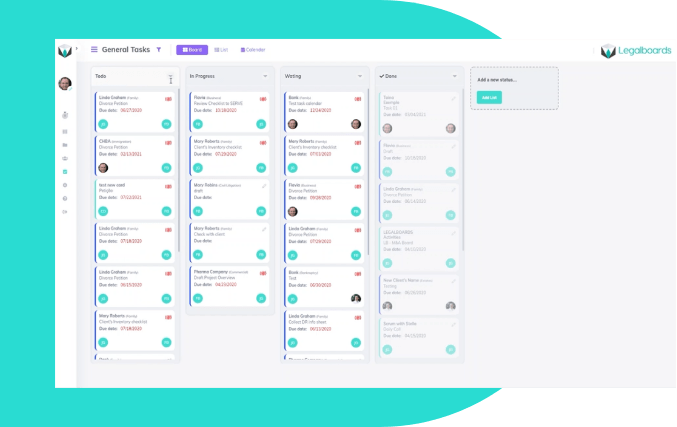
    With Legalboards you can easily visualize and organize your matters. The minimal Kanban user interface allows you to see at a glance what stage your matters are at without having to open each case file. Through customizations to the board, you can tailor your account to reflect your workflow accurately.

    As you can see in the screenshot below, how your work is progressing in Legalboards can be understood at a glance. It’s up to you how customized you want to make your board/cards. With the customization capabilities, you can add checklists and custom labels (including colours) to cards so you can quickly navigate your matters.

    Legalboards screenshot

    By integrating Clio, your data will be automatically synced. Synced data means you don’t need to input updates twice. Within the task center, Legalboards also has a calendar view so you can see your task’s timeline in a simple format.

    3) Get Integrated

    By integrating your Clio account with Legalboards you can get organized and save time through our automation capabilities and easy-to-understand interface. These are just two of the benefits of adding Legalboards to Clio, and some can be specific to practice areas.

    Find us in Clio’s App Directory here, and start your free trial with us here.